
Android vs iPhone: Which Is More Popular in the US?
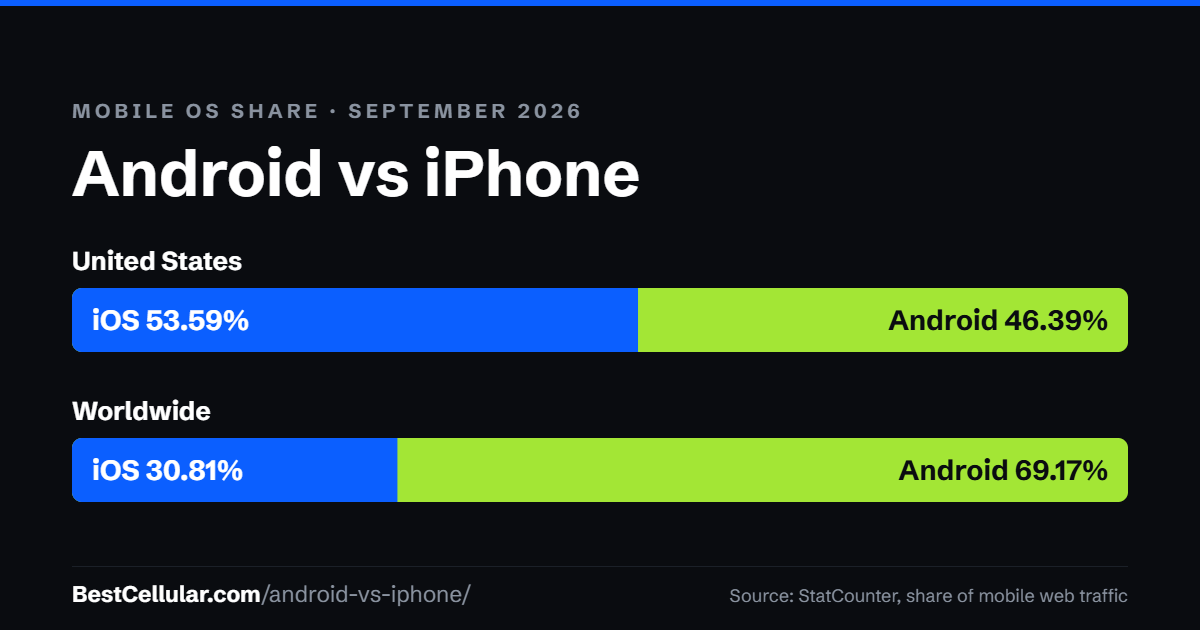
In the United States, iPhone leads Android. iOS accounted for 53.59% of US mobile web traffic in September 2026, against 46.39% for Android. Worldwide it is the reverse: Android carried 69.17% and iOS 30.81%. Source: StatCounter, September 2026.
StatCounter measures share of mobile web traffic, not phones sold or phones in use. iPhone owners browse more per device, so traffic share can run ahead of ownership. It is still the most current public measure, updated every month.
Android vs iPhone market share, September 2026
| Region | iOS (iPhone) | Android |
|---|---|---|
| United States | 53.59% | 46.39% |
| Worldwide | 30.81% | 69.17% |
Figures are share of mobile operating system web traffic from StatCounter Global Stats. The remainder is other systems.
Android vs iPhone when you switch carriers
Popularity matters less than one practical question: will your phone work on the carrier you are moving to? Either system works on every major US network, but three things decide whether your specific phone moves cleanly.
- It must be unlocked. A carrier-locked iPhone or Android phone will not accept another carrier’s service until the old carrier unlocks it.
- It must support the new network. Check the exact model with the free device check before you buy a SIM or a plan.
- It must take the right SIM. Every US iPhone since the iPhone 14 is eSIM only, with no SIM tray. Current Samsung Galaxy and Google Pixel phones sold in the US take both eSIM and a nano SIM. See what is an eSIM and the SIM card size chart.
Your phone number moves the same way on either system. It travels by port, using the account number and transfer PIN from your current carrier. Find both in the transfer PIN lookup.
Switching from iPhone to Android, or Android to iPhone
Changing systems is a separate job from changing carriers. Do it in this order and nothing gets lost:
- Move your data with the official app. Going to iPhone, Apple’s Move to iOS app on Android copies contacts, messages, photos and accounts. Going to Android, Google’s Switch to Android app on iPhone does the same.
- Turn off iMessage before you leave iPhone. Otherwise texts from iPhone users can keep going to iMessage instead of your new phone. If you already switched, Apple’s Deregister iMessage page removes your number.
- Move the number last. Port the number only once the new phone is set up and working. Do not cancel the old service first; cancelling releases the number. The full sequence is in how to switch carriers without losing your number.
Which should you choose?
Choose the one whose phones fit your budget and the people you message most. In the US, where more than half of mobile traffic is iPhone, families and friend groups often standardize on one system for shared features. Android gives you a far wider range of prices and manufacturers. Either will run on any carrier, which is the decision that actually saves money: compare every US carrier by network.
Android vs iPhone questions
Is iPhone or Android more popular in the US?
iPhone. iOS had 53.59% of US mobile web traffic in September 2026, against 46.39% for Android, according to StatCounter.
Is Android or iPhone more popular worldwide?
Android, by a wide margin: 69.17% of worldwide mobile web traffic in September 2026, against 30.81% for iOS.
Can I keep my phone number if I switch from iPhone to Android?
Yes. The number belongs to your account, not your phone. It moves by port when you change carriers, and stays put when you only change phones on the same carrier.
Do all carriers work with both iPhone and Android?
Yes, every major US carrier supports both. What can stop a specific phone is a carrier lock or a missing network band, which the device check catches before you pay for anything.