
List of US Cell Phone Carriers and MVNOs (2026)
317 providers · Verified October 2026 · Free to reuse with credit
Every US provider you can port a phone number away from, mapped to its host network — the carrier that actually carries the call. 317 providers — mobile, MVNO, VoIP and wireline. Download it, chart it, republish it, build a product on it. Credit BestCellular.com and link back to this page, and you are done.
Download the CSV Download the JSON Read the table first
What is in the host network file
One row per provider. Seven columns, no nesting, opens in anything. The host network column is the one most people come for.
Both files are generated from the dataset at the moment you download them, so the copy you get is never older than the page you are reading.
| Column | What it holds |
|---|---|
| provider | The brand name as the company writes it. |
| slug | Our identifier for the provider. |
| url | Our page for that provider, with its port-out instructions. |
| host_network | Verizon, T‑Mobile, AT&T, More than one, or Own network. Blank when not confirmed. |
| type | mobile, voip or wireline. |
| status | confirmed or not confirmed. |
| verified | The date this dataset release was generated. Each carrier page shows when that carrier’s steps were last checked against a source. |
Providers by host network
Counts are absolute. Shares are rounded to the nearest whole percent, so they may not total exactly 100.
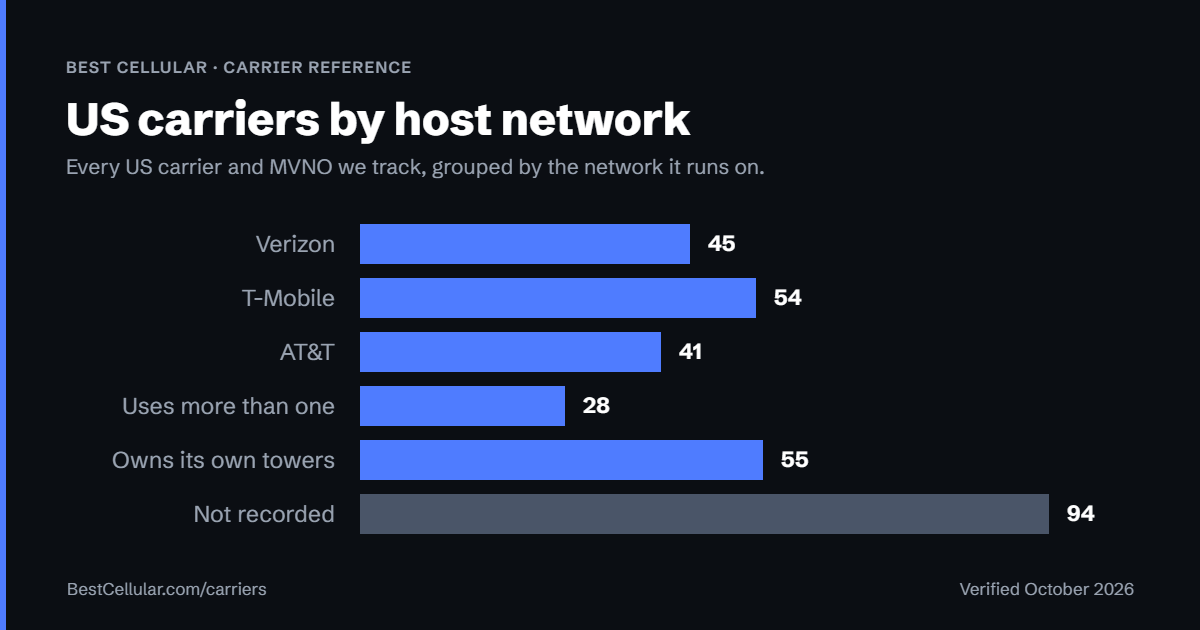
| Host network | Providers | Share |
|---|---|---|
| Verizon | 45 | 14% |
| T-Mobile | 54 | 17% |
| AT&T | 41 | 13% |
| More than one | 28 | 9% |
| Own network | 55 | 17% |
| Not confirmed | 94 | 30% |
How to read the host network column
Six values appear in that column, and two of them trip people up.
- Verizon, T‑Mobile or AT&T — the provider rides that host network directly. Coverage matches that network in the places you care about.
- More than one — the provider sells service on two or more host networks. Which one you land on can depend on the plan, the SIM you were issued, or the state you activated in. Check before you assume.
- Own network — the provider runs its own towers or its own wireline plant rather than renting capacity. The three national networks plus regional and rural operators.
- Blank — status reads not confirmed. See below.
The host network decides your coverage. The logo on the bill does not. Two providers on the same host network give you the same bars in the same place, whatever their marketing says about speed.
What counts as a provider
Anything you can port a US phone number away from. Postpaid and prepaid carriers, MVNOs, connected-device brands, VoIP services and wireline telephone companies. Landline and VoIP port-outs are where most switching guides give up. Covering them is deliberate.
What “not confirmed” means
The provider is real and its numbers are portable, but we have not tied it to a host network with a source we would publish. It is never a guess left in the file. Several providers simply refuse to say: one tells customers only that it runs on “America’s fastest network”, another names a reseller instead of a carrier, a third says “nationwide carriers” and stops.
What the defunct column means
A record marked defunct is a provider that has stopped selling service. It stays in the file. Its numbers were ported somewhere, and the people searching for those records are usually trying to work out where a number went. Removing them would delete the answer.
For a defunct provider, the host network column records the network its numbers ran on while it operated. It does not record where a former customer’s number lives today. Those are two different facts and the file carries only the first.
The JSON payload reports how many records carry the flag in defunct_count. The CSV carries the same value per row in the defunct column.
What this dataset does not cover
The FCC’s Form 499 filer database lists roughly 7,000 active US telecommunications providers. Most of them are wholesale carriers, holding companies or business-only VoIP resellers that no consumer has ever ported a number away from. This dataset covers the consumer-facing brands people actually switch away from — 317 of them — not the regulatory universe. We would rather tell you that than imply a coverage we do not have.
For the record, here is what that 7,000 is made of: roughly 4,000 interconnected voice-over-internet providers, 1,160 incumbent local telephone companies, 735 competitive local carriers, 442 local resellers, 360 cellular operators, and a long tail of cable telephone, paging and shared-tenant providers. Most never sell to a household. The ones that do are the ones in this file, and every one of them is tied to a host network or marked as unconfirmed.
How to cite this
Copy whichever line fits where you are publishing.
Plain text
BestCellular.com. “2026 US Carrier and MVNO List,” 317 providers, verified October 2026. https://bestcellular.com/data/
HTML, with the link
Source: <a href="https://bestcellular.com/data/">Best Cellular carrier dataset</a> (317 providers, verified October 2026)
You can reuse this
Published under a Creative Commons Attribution 4.0 licence. In plain English:
- You can copy it, chart it, put it in a report, build a product on it, and sell that product. Commercial use is fine. You do not need to ask us.
- You must credit BestCellular.com and link back to this page. That is the whole price.
- Note: facts are not ours to own and we are not claiming them. The licence covers this compilation — the work of collecting, checking and structuring it.
Licence in full: creativecommons.org/licenses/by/4.0. Want a live feed instead of a file, or a bigger reuse? Tell us what you need.
How a record gets confirmed
- The provider’s own words. Coverage maps, access point name settings, device compatibility pages, support articles, terms of service.
- The public record. Federal Communications Commission registrations and filings, and state utility commission listings.
- Two sources or it waits. One source is a lead, not a fact. Anything we cannot corroborate stays marked not confirmed until it can be.
Where to go next
Every carrier we track, by network · Free wireless tools
Maintained by BestCellular.com, a brand of Assertive Holdings, LLC. The canonical copy of this dataset lives at bestcellular.com/data/ — always current, always dated.