
SIM card reference
SIM Card Sizes: Nano, Micro, Mini and Full-Size, With Exact Dimensions
There are four physical SIM card sizes, plus the eSIM built into most new phones. Almost every phone made in the last decade that still has a SIM tray takes a nano SIM. Every iPhone sold in the US since the iPhone 14 has no tray at all.
Managed by M. Curtis McCoy · Last reviewed October 12, 2026 · How we make money
The short answer
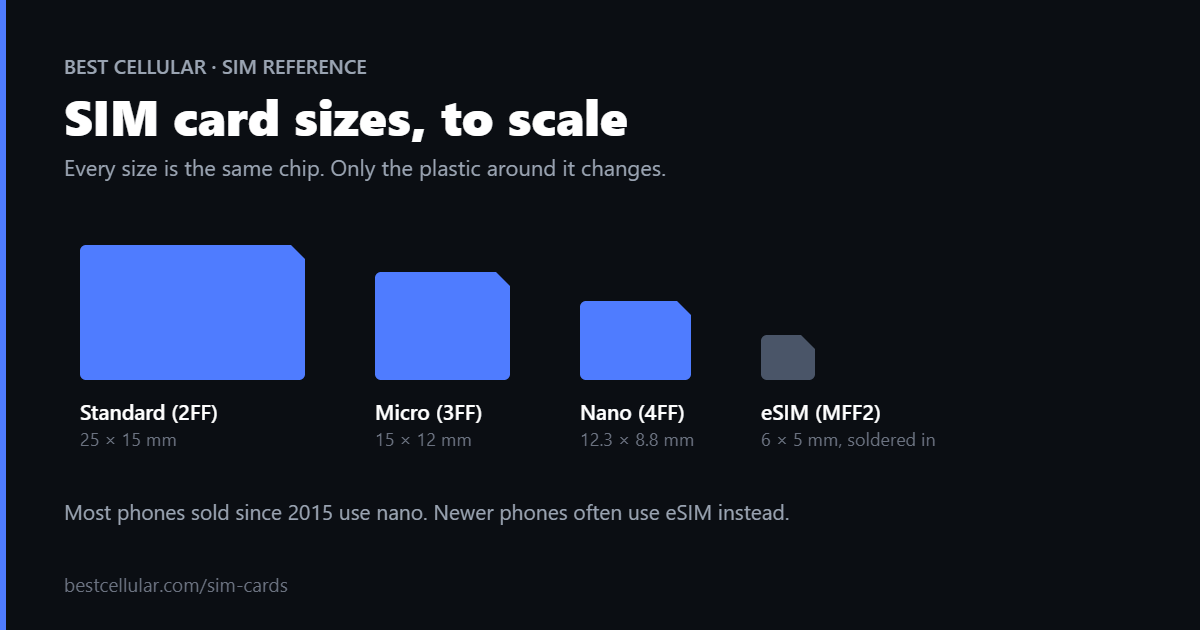
From largest to smallest, the four SIM card sizes are full-size (1FF) at 85.6 × 53.98 mm, mini or “standard” (2FF) at 25 × 15 mm, micro (3FF) at 15 × 12 mm and nano (4FF) at 12.3 × 8.8 mm. Nano is the size almost every current phone uses. All four carry the same chip and the same contacts; only the plastic around the chip changes. An eSIM is not a card at all. It is a chip soldered inside the phone that your carrier programs over the air.
SIM card sizes chart
All SIM card sizes below are the same chip with more or less plastic around it. The gold contacts are identical, which is why one SIM card can be punched out to fit three different trays.
| Size | Also called | Millimetres | Inches | Thickness | Introduced |
|---|---|---|---|---|---|
| Nano SIM | 4FF | 12.3 × 8.8 mm | 0.48 × 0.35 in | 0.67 mm | 2012 |
| Micro SIM | 3FF | 15 × 12 mm | 0.59 × 0.47 in | 0.76 mm | 2003 |
| Mini SIM | 2FF, "standard" SIM | 25 × 15 mm | 0.98 × 0.59 in | 0.76 mm | 1996 |
| Full-size SIM | 1FF | 85.6 × 53.98 mm | 3.37 × 2.13 in | 0.76 mm | 1991 |
| eSIM | Embedded SIM, eUICC | A chip soldered inside the phone. Nothing to insert or remove. | 2016 | ||
Which SIM card size does my phone take?
If your phone has a SIM tray and was made in the last ten years, it almost certainly takes a nano SIM. Every iPhone with a tray since the iPhone 5 (2012) uses nano, and so do current Samsung Galaxy, Google Pixel and Motorola phones that still have a tray.
To check your exact phone, look for “Nano-SIM” or “eSIM” on the manufacturer’s technical specifications page, or pop the tray out with a SIM tool and compare it with the SIM card sizes in the chart above. If your iPhone is a US model from the iPhone 14 on, there is no tray: it is eSIM only.
Not sure your phone will work on a new carrier at all? Run it through the free device compatibility check before you buy anything.
Nano SIM (4FF): 12.3 × 8.8 mm
The nano SIM is the smallest physical SIM card and the one nearly every phone uses today. It measures 12.3 × 8.8 mm and is 0.67 mm thick, slightly thinner than the older sizes. That extra thinness is why a nano SIM can feel loose in an adapter and why cutting a larger card down to nano rarely fits cleanly.
Nano SIM cards ship from carriers as the innermost piece of a 3-in-1 card, so you can press it out of the plastic frame by hand.
Micro SIM (3FF): 15 × 12 mm
The micro SIM measures 15 × 12 mm. It went mainstream in 2010, when the original iPad and the iPhone 4 used it. Today you will mostly find micro SIM slots in older phones, some mobile hotspots and tablets, and connected devices like GPS trackers.
Mini SIM (2FF), the "standard" SIM: 25 × 15 mm
The mini SIM is 25 × 15 mm. Carriers and retailers still call it the “standard” SIM, which confuses people: it is not the standard size for phones anymore. It survives in basic flip phones, older phones, routers, alarm panels and vehicle trackers.
Full-size SIM (1FF): 85.6 × 53.98 mm
The full-size SIM is the size of a credit card, 85.6 × 53.98 mm. It was the original 1991 format for car phones and the first portable phones. No phone uses it today, but you still hold one every time you open a new SIM kit: the credit-card frame you punch the smaller sizes out of is the full-size format.
Micro SIM vs nano SIM: what is the difference?
Only the plastic. A nano SIM is 2.7 mm shorter, 3.2 mm narrower and 0.09 mm thinner than a micro SIM. The chip, the contacts and the account it carries work exactly the same. A nano SIM will work in a micro SIM slot with an adapter; a micro SIM will not fit a nano tray unless it is cut, which risks damaging the chip.
eSIM: the size that is not a card
An eSIM is a SIM chip built into the phone. The chip itself is a few millimetres square and soldered to the board, so there is nothing to insert, lose or swap. Your carrier sends the account profile over the air, usually by QR code or an app, and a phone can store several profiles at once.
In the United States, every iPhone since the iPhone 14 is eSIM only. Most new Android flagships support both eSIM and a nano SIM. For a full walkthrough, read SIM cards and eSIMs: what you actually need.
Do you need a different SIM card size to switch carriers?
Almost never. SIM card sizes stopped being a switching problem years ago: new SIM cards from every major US carrier ship as 3-in-1 cards that pop out as mini, micro or nano, so the size takes care of itself. Your phone number is not stored on the SIM card. It moves through a port, using the account number and transfer PIN from your old carrier.
Find both for your current carrier with the transfer PIN and account number lookup, then follow the five steps to switch carriers without losing your number.
Can you cut a SIM card down or use an adapter?
Use an adapter if you have to; avoid cutting. Adapters let a nano SIM sit in a micro or mini slot and cost very little, but a loose adapter can snag inside a tray, so seat it carefully. Cutting a micro SIM down to nano is a gamble: nano cards are thinner than micro cards, the chip sits close to the edge, and one slip kills the card.
The safer option is free: ask your carrier for a replacement SIM in the right size. Most will mail one at no charge or hand one over in a store.
SIM card sizes: common questions
How many SIM card sizes are there?
Four physical sizes: full-size (1FF), mini (2FF), micro (3FF) and nano (4FF). The eSIM is a fifth format, but it is a chip built into the phone rather than a removable card.
What is the most common SIM card size?
Nano SIM (4FF), at 12.3 × 8.8 mm. Almost every phone made in the last decade that has a SIM tray takes a nano SIM.
Are SIM card sizes universal?
Yes. The sizes are set by the ETSI TS 102 221 standard, so a nano SIM from any carrier fits any nano SIM tray. Whether it works is a separate question: the phone must be unlocked and support the new carrier’s network.
Is a standard SIM the same as a mini SIM?
Yes. “Standard SIM” is the common name for the mini SIM (2FF), 25 × 15 mm. Despite the name, it is no longer the standard size for phones.
Can I put a nano SIM in a micro SIM slot?
Yes, with a SIM adapter. The adapter fills the extra space around the nano card. Seat it carefully so it does not catch inside the tray.
Do all carriers use the same SIM card size?
Yes. Verizon, AT&T, T-Mobile and the brands that run on their networks ship 3-in-1 SIM cards that pop out as mini, micro or nano, and most now support eSIM as well.
Do I need a new SIM card to keep my phone number?
No. Your number is not stored on the SIM card. It moves to the new carrier through a port, using your account number and transfer PIN from the old carrier.
Switching carriers? Start with the number, not the SIM
The SIM card is the easy part. The step that trips people up is getting the account number and transfer PIN from the carrier you are leaving.
Sources: SIM dimensions from ETSI TS 102 221, the smart card standard for SIM cards. US iPhone eSIM-only status from Apple’s iPhone 14 and later specifications. Best Cellular is not a wireless carrier and sells no SIM cards. Some links on this site earn a commission at no extra cost to you; here is how that works.