
Coverage
Cell Phone Coverage Map by Carrier
All 230 US carriers matched to the network that actually carries the signal · Last reviewed September 21, 2026
Managed by M. Curtis McCoy · How we make money
Free tool
Which network does your carrier actually use?
Type a carrier or a network. You get the host network, the right coverage map, and an independent check for your own address.
230 US carriers and the three nationwide networks.
Your carrier’s coverage map is really its network’s map
Mint Mobile does not own towers. Neither does Cricket, Visible, Boost, Consumer Cellular or Straight Talk. They buy wholesale access to one of the three nationwide networks and resell it under their own name. So when you search for a Mint Mobile coverage map, the accurate answer is T-Mobile’s map, because T-Mobile is the network carrying the call.
This is the most useful thing to understand before you switch. A reseller cannot reach further than the network it rents. It can be cheaper. It cannot have better coverage.
Seven carriers in our database are the exception. They own and operate towers in a defined region, so their coverage map is genuinely their own.
What a coverage map does not tell you
Every carrier coverage map is a prediction, not a measurement. Carriers build them from tower locations, transmitter power and terrain models. Nothing on the map was measured at your address, and no map is a guarantee of service.
Four things change what you actually experience, and none of them appear on a coverage map:
- Data priority. When a tower is congested, the network serves its own premium customers first. Resold and lower-cost plans can slow down at exactly the moment the tower is crowded. Priority is set per plan by the host network, so check the brand’s own terms rather than assuming.
- Roaming rights. A network’s own customers often roam onto partner towers where the network itself has no equipment. Resellers are sometimes excluded from that roaming. Same map, different edge of the map.
- Which bands your plan includes. Low-band spectrum near 600 and 700 MHz travels a long way and passes through walls. Mid-band carries the fast 5G speeds over a much smaller area. Some plans exclude mid-band 5G entirely.
- Your phone’s radios. A phone missing the band a network leans on in your area will show weak service in a place the coverage map paints solid.
Check your address on an independent coverage map
The Federal Communications Commission publishes the National Broadband Map. Providers are required to report where they offer mobile service, the map is searchable by street address, and consumers can formally challenge coverage that is reported but not there. It is the only nationwide map of its kind that is not published by a company trying to sell you service.
Open the FCC National Broadband Map
Enter your address and compare the providers listed. Reported coverage is still reported rather than measured, but the reporting is a legal obligation and open to challenge, which is more than a marketing map offers.
The three official coverage maps
If your carrier resells one of these networks, that network’s coverage map is your map.
AT&T coverage map T-Mobile coverage map Verizon coverage map
How the 230 carriers break down
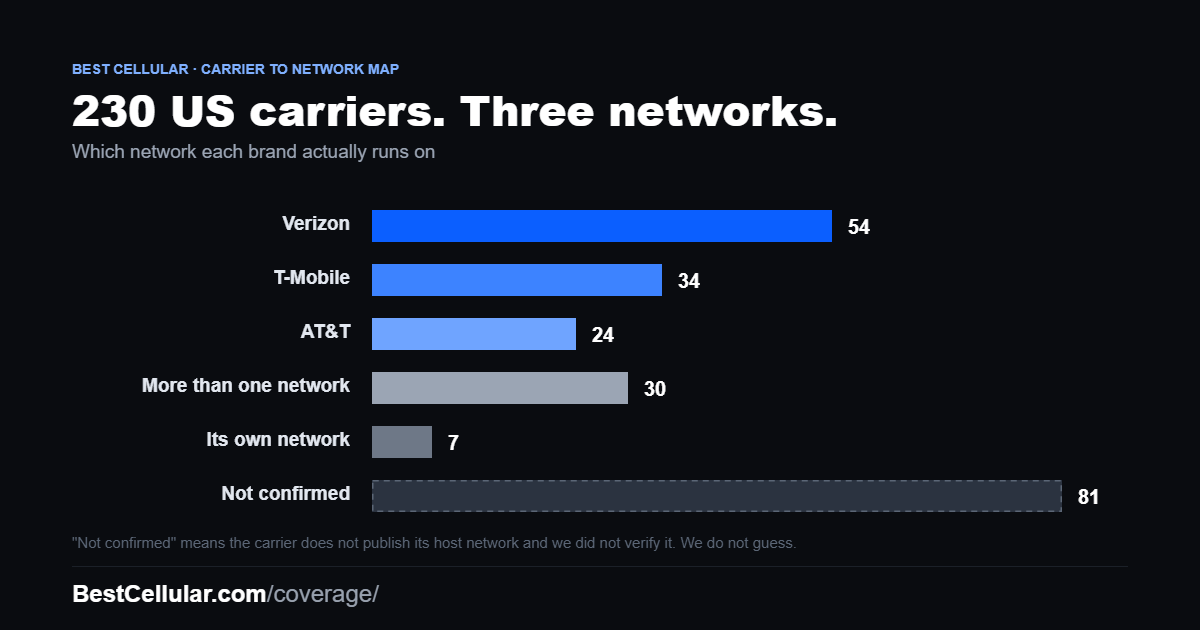
| Network the brand runs on | Carriers |
|---|---|
| Verizon | 54 |
| T-Mobile | 34 |
| AT&T | 24 |
| More than one network | 30 |
| Its own network | 7 |
| Not confirmed | 81 |
A carrier is marked not confirmed when the company does not publish its host network and we could not verify it against a primary source. We do not guess, because a wrong answer here costs somebody a working phone. See the full list of 230 carriers and their networks.
Coverage at home is not coverage on the road
Most people pick a carrier for one address and then live with that choice everywhere else. Before you commit, trace the map along the roads you actually drive: the commute, the job sites, the family visit, the stretch of highway with no exits. The gaps that matter are usually rural highway rather than town, and the three networks do not have the same gaps. Checking one route on all three coverage maps takes about a minute and settles the question better than any review.
Common questions about coverage maps
Which carrier has the best coverage in my area?
There is no national answer. Open all three official maps at your home address and at your work address, then check the same addresses on the FCC map. The network that wins both is the one to buy from, and every reseller on that network has the same footprint.
Does a cheaper carrier mean worse coverage?
Not in footprint. A budget brand on Verizon covers exactly what Verizon covers. What can differ is speed when the tower is busy, roaming, and which 5G bands the plan includes.
Can I test a network before I move my number?
Yes, and you should. Buy a cheap prepaid SIM or an eSIM trial on that network and run it for a week at home, at work and on your commute. Do not cancel anything and do not start a port until it passes.
Does the 5G layer on a coverage map matter?
Sometimes. The wide 5G area on every map is low-band 5G, which performs close to LTE. The fast 5G is mid-band, and it covers a fraction of the same ground. Compare the mid-band layer, not the outer one.
Is a coverage map a guarantee?
No. Carrier maps are estimates and every carrier says so in the fine print. Treat a map as a shortlist, not a promise.
Why does my phone show full bars but nothing loads?
Bars measure signal from the tower, not capacity on it. A congested tower shows a strong signal and delivers almost no throughput. That is also where data priority decides who gets served first.
Once you have picked a network
Coverage decides the network. After that, moving your number takes two pieces of information your current carrier does not volunteer: the account number and the transfer PIN.
Look up your account number and transfer PIN · Browse all 230 carriers · How to switch carriers without losing your number