
Free counter tool
Transfer PIN lookup for 228 US carriers
Type the carrier the customer is leaving. You get the account number, the transfer PIN and the phone number to call, all on one screen. No signup, no login, nothing to install.
228 US carriers, checked against each carrier’s own documentation.
What you get
Four things, for every carrier in the database: where the account number lives, how the customer gets a transfer PIN, the port-out phone number to call when the app will not produce one, and the network the carrier runs on so you can check coverage before you sell.
Where a carrier does not publish one of those, the field says so. It is not filled in with a guess.
How to use this at the counter
- Ask what they have now. Type the brand into the box above. The name on the bill is enough — “Mint”, “Straight Talk”, “the Walmart one”.
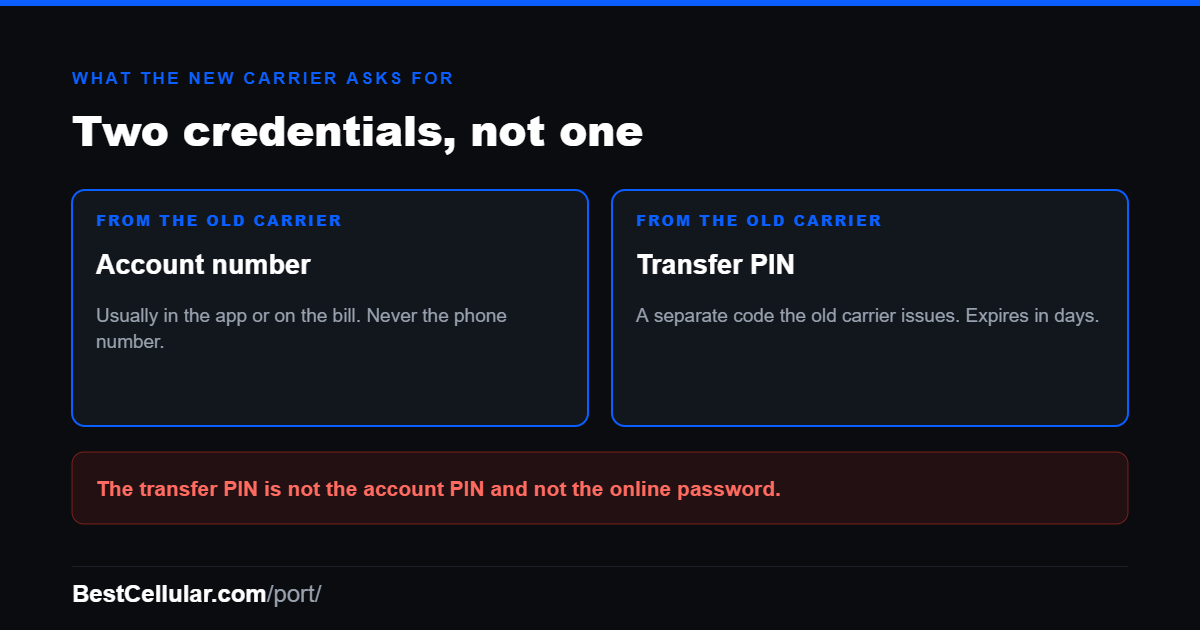
- Read them the two steps. The account number and the transfer PIN both come from their old carrier. Neither one comes from you, and neither one is their phone number.
- Start the port on your system. Never have the customer cancel the old line first. Canceling releases the number and it is gone permanently.
Text the steps to the customer before they leave. Half of failed ports are a customer who walked out, forgot which app to open, and never came back.
What carriers call the transfer PIN
The same thing goes by at least five names. A customer who says “they already gave me my PIN” may be holding the wrong one.
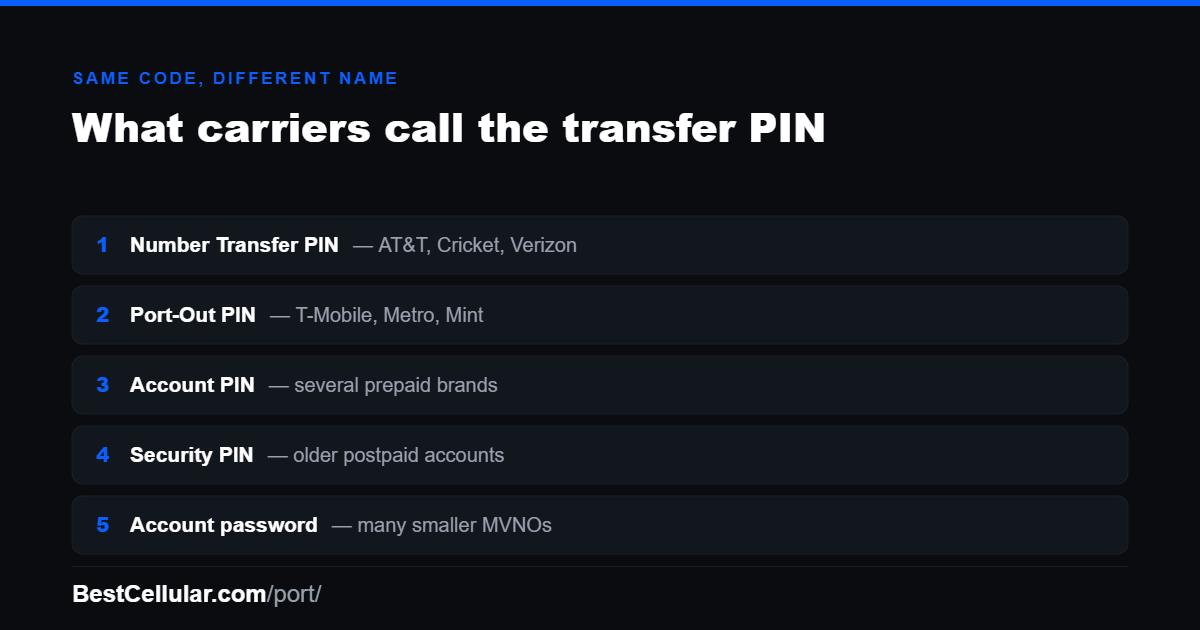
The test is what the code does. A transfer PIN releases the number. An account PIN protects the account and should never be handed to a new carrier.
Why a port gets rejected
Five causes account for almost every failure. Four are fixable at the counter in under five minutes.
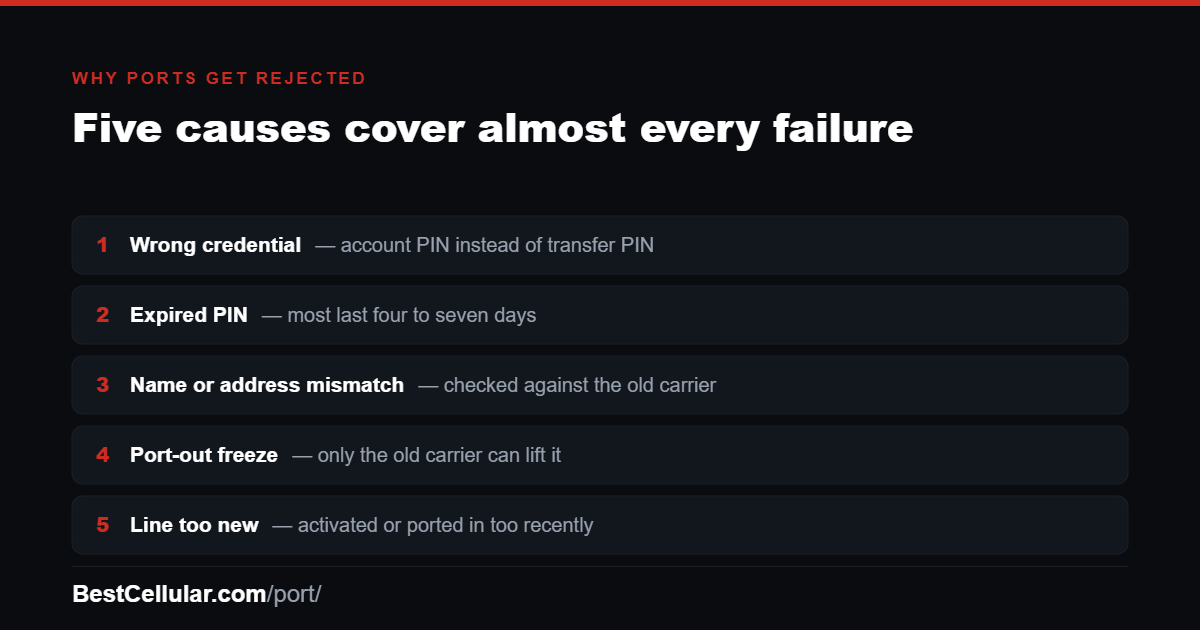
The customer gave you the wrong number
The number transfer PIN is not the account PIN, not the voicemail password and not the online login. It is a separate code the old carrier issues for exactly this purpose.
The transfer PIN expired
Most transfer PINs are valid for four to seven days. If the customer generated one last week, it is dead. Have them pull a fresh one before you submit.
The name or address does not match
The port request is matched against what the old carrier has on file, not against the customer’s ID. A maiden name, an old billing ZIP or a middle initial on one record and not the other will reject the port. Correct it with the old carrier first, then resubmit.
The number is locked
Some carriers apply a port-out freeze by default and some let the customer switch one on. It has to be lifted by the old carrier. The customer has to call — you cannot lift it from your side.
The line is too new
A number activated in the last few days, or ported in within the last 30, is refused by several carriers. There is no workaround other than waiting it out.
How long a port takes
The FCC’s consumer guide is the source worth quoting to a customer who is nervous about losing service: “You may be able to use your phone within a few hours for changes among wireless service providers.” Landlines are slower — “porting from wireline to wireless service may still take a few days.”
Tell the customer to keep the old SIM in the phone until the new line activates. The number moves on the carrier’s schedule, not yours, and a customer who pulls the old SIM early spends the gap with no service and calls you about it.
What the customer owns and what the carrier owns
The number belongs to the customer. The FCC states it plainly: “Once you request service from a new company, your old company cannot refuse to port your number, even if you owe money for an outstanding balance or termination fee.” An unpaid balance stays a debt. It is not a hold on the number.
The SIM belongs to the carrier. The number does not. Full text: Portability: Keeping Your Phone Number When Changing Service Providers.
Questions reps get asked
Can I port a number that is not in my name?
Not usually. The port is matched against the account holder on file at the old carrier. The account holder has to request the transfer PIN or be added to the account first.
Does the customer have to cancel the old service?
No, and they should not. The old line closes itself when the number leaves. Canceling first releases the number back into the pool and it cannot be recovered.
What if the carrier is not in the list?
Tell us and it gets added. The database covers 228 US carriers; new brands launch constantly and dead ones get absorbed.
Can a customer port a landline number to a cell phone?
Yes, within the same geographic area, and it takes longer than a wireless port. The landline account has to stay open until the port completes.
Put this on your counter
The printable version is free to download and free to hand out. It is 5.5 × 8.5 inches at 300 dpi, sized for a standard half-letter card, and it prints double-sided.
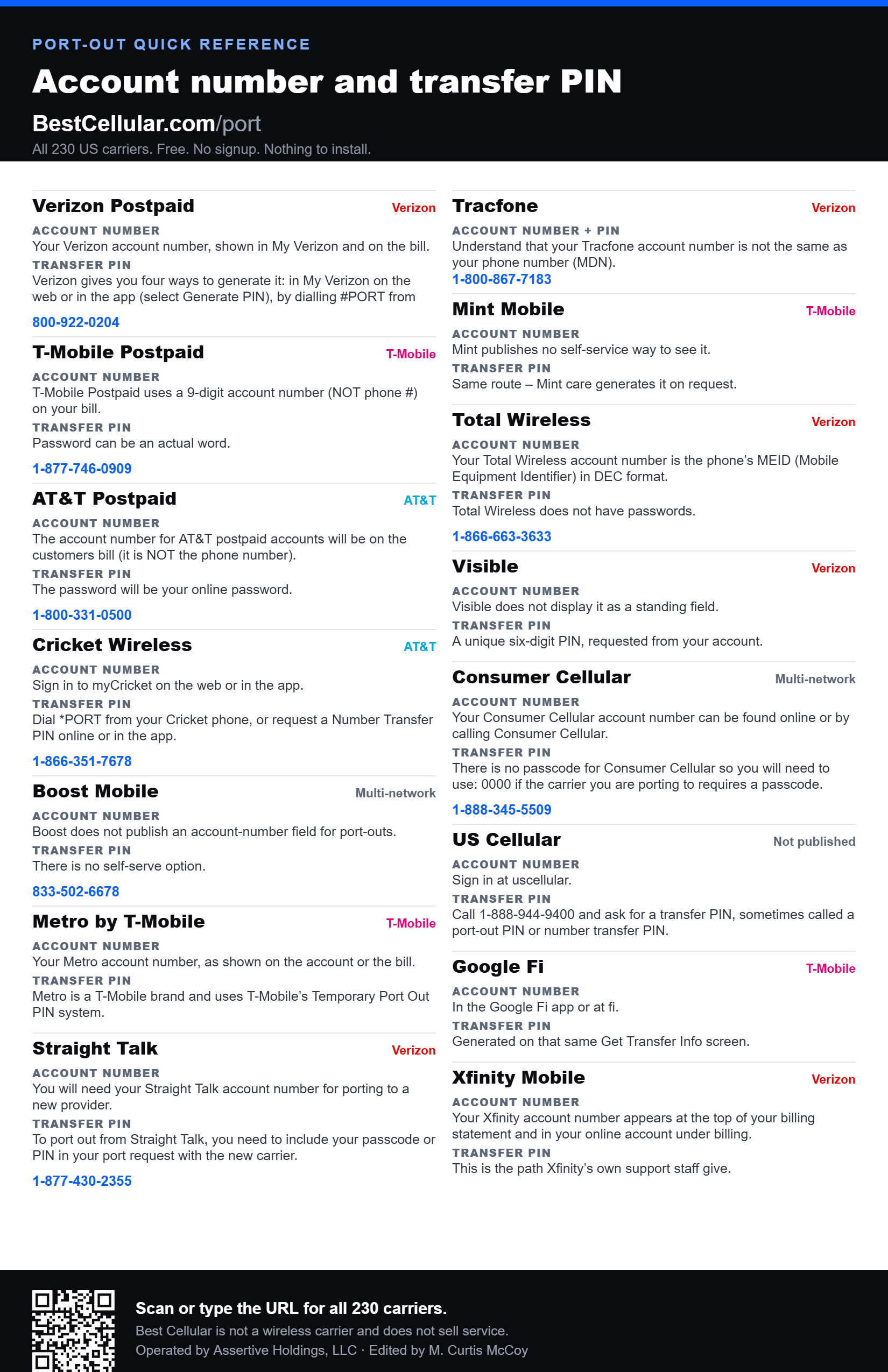
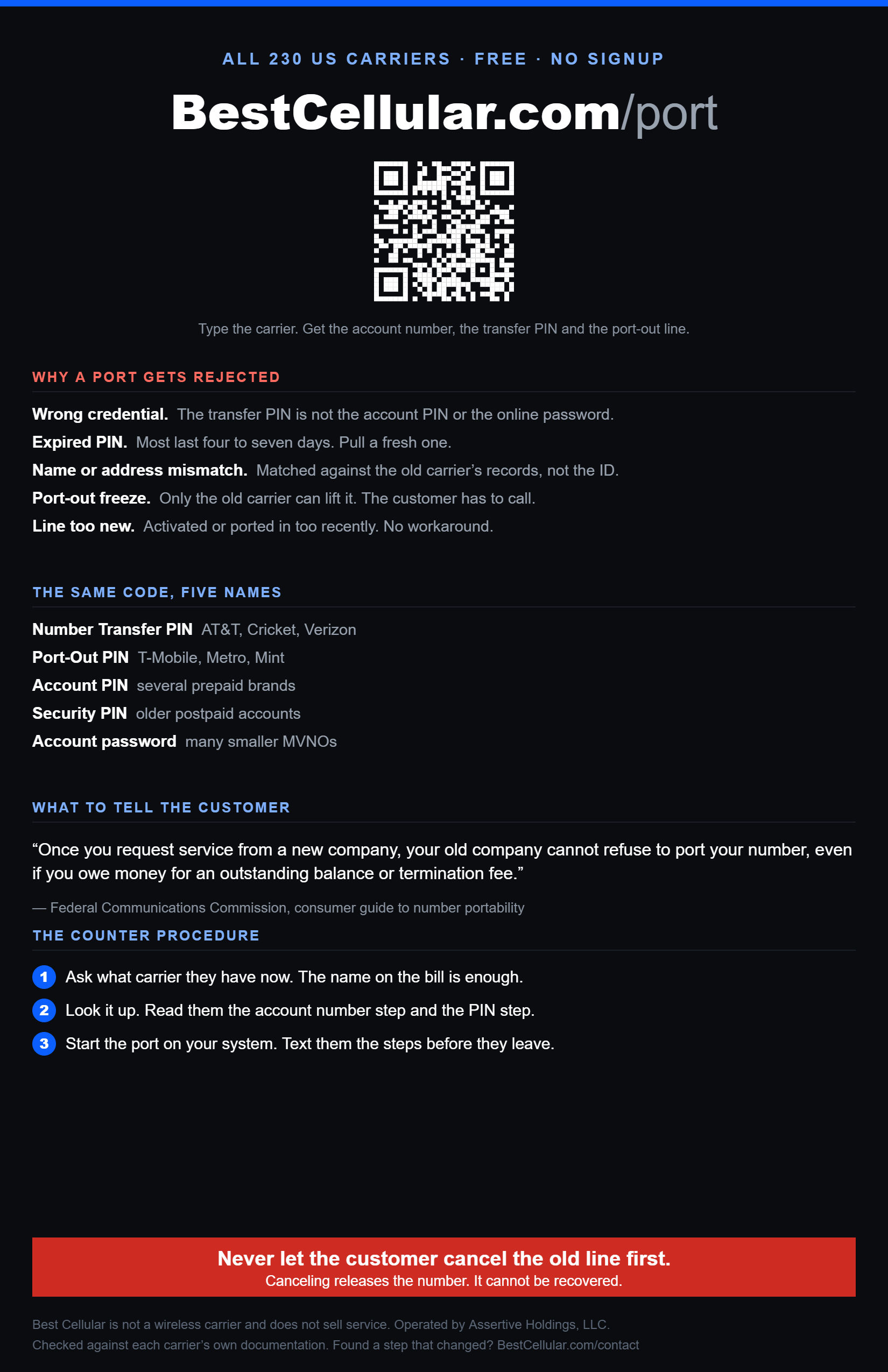
Download the front (PNG, print resolution) · Download the back
Want them printed and mailed instead? Stores, repair shops and independent dealers can ask for cards — say how many. There is no cost and nothing to sign.
Print it, post it, hand it to a competitor. The only thing asked in return is that a correction gets sent back when a carrier changes its process.
Who runs this
Best Cellular is operated by Assertive Holdings, LLC and edited by M. Curtis McCoy. We are not a wireless carrier and we do not sell service. We are not owned by a carrier and we are not a reseller for one, which is why this transfer PIN lookup covers all 228 instead of the handful that pay.
Every record is checked against the carrier’s own published support documentation. 81 of the 228 carriers we track will not say whose towers they use — that gap is real, and pretending otherwise is how a rep promises coverage that does not exist.
Carriers change their port-out process without announcing it. If a step here is out of date, tell us and it gets corrected. How we make money. Full guide to switching carriers.